ZONOS3-Mini
Introducing ZONOS3-Mini, a compact zero-shot voice-cloning Text To Speech (TTS) model with state-of-the-art performance as well as leading voice control capabilities which can run in real-time on-device.
Read the post
Introducing MAIA: AI That Makes Teams Better Together
Our mission at Zyphra is to make open superintelligence accessible to everyone through a full stack spanning frontier models, multisilicon infrastructure, and agentic applications. Today, we're excited to introduce MAIA in beta, the application layer that brings this vision directly to people and teams. MAIA is a proactive, multiplayer AI agent that remembers shared context, takes action across tools, and helps teams turn knowledge into outcomes. This beta is an early step toward making powerful intelligence more accessible, useful, and under the control of those who use it. We invite you to try MAIA and help shape what comes next.
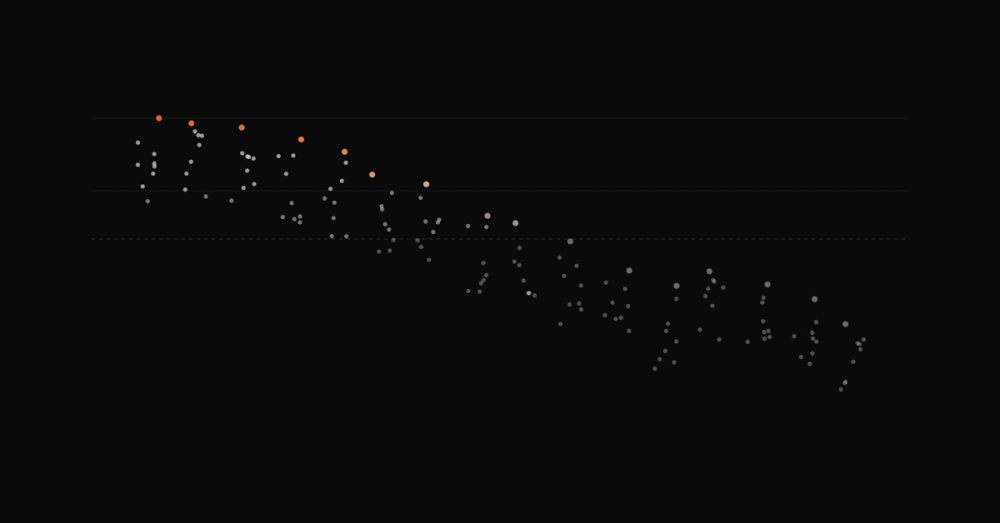
ZYFA: Fast and Accurate FP8 Attention on AMD MI355X
Zyphra presents ZYFA (Zyphra FlashAttention on AMD) - FP8 and BF16 prefill attention kernels for AMD Instinct MI355X GPUs. ZYFA is part of the attention engine of our Zyphra Optimization Engine (ZOE) on AMD MI355X GPUs, powering our inference cloud and on-prem deployments. We show that FP8 matrix instructions offer twice the peak throughput of BF16, but attention kernels fall well short of a 2x speedup in practice. On the MI355X at 32K tokens, the FP8 attention kernel of AITER (AMD’s library of inference kernels) reaches 39% of the FP8 peak, while its BF16 kernel reaches 49% of the BF16 peak. FP8 speeds up only the two matrix multiplications of attention, so the softmax between them becomes the bottleneck. ZYFA’s FP8 kernels shrink the softmax, overlap it with the matrix multiplications, and keep the 8-bit probabilities accurate. On attention inputs captured from three models and timed at sustained clock speeds (the steady clock under continuous load), they achieve 1.16–1.76× the throughput of AITER’s default kernels (Figure 1), and at head dimension 128 their numerical error is 62–78% lower than that of AITER’s FP8 kernel. This post summarizes our paper, and the source code is available at github.com/Zyphra/zyfa.
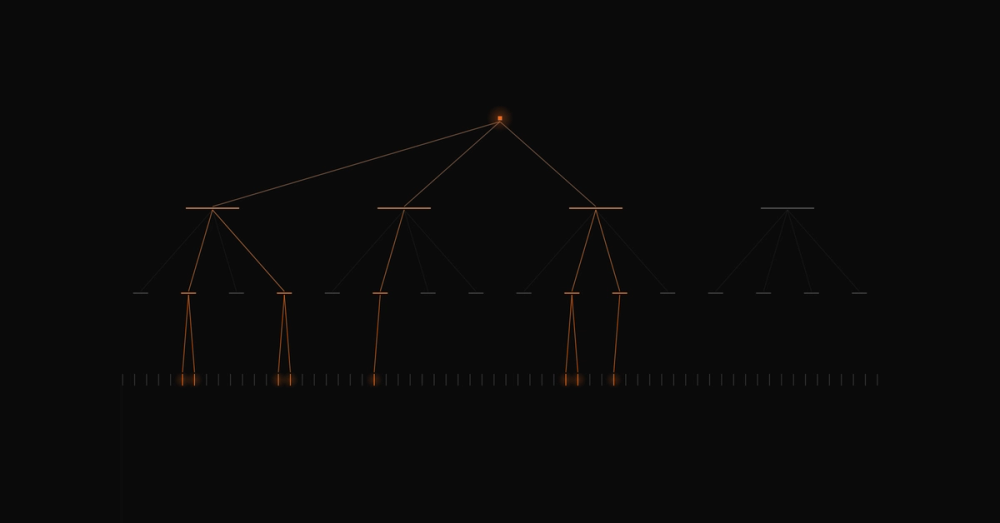
ZHA: Zyphra Hierarchical Attention
We introduce Zyphra Hierarchical Attention (ZHA), a sparse attention method that constructs and searches through a hierarchical tree to determine the relevant set of tokens for each query. ZHA achieves subquadratic complexity with suitably chosen top-p thresholds for routing, outperforming existing sparse-attention methods which maintain a quadratic indexer. We demonstrate that we can adapt existing pretrained models to ZHA through a distillation phase using only a few billion tokens, and that ZHA maintains performance on challenging long-context reasoning, agentic coding, and retrieval benchmarks at high levels of sparsity. Our performance model shows that ZHA dramatically outperforms sparse attention methods in speed and computational cost at ultra-long contexts.
Zyphra Inference Wave 2: Faster MoE and Long-Context Serving on MI355X
Zyphra presents the second wave of inference optimizations in the Zyphra Optimization Engine (ZOE) for AMD Instinct MI355X GPUs. We measure the empirical compute and memory-bandwidth limits of the MI355X, write custom HIP kernels for mixture-of-experts layers and sparse attention in our production forks of vLLM and SGLang, and evaluate MXFP4 quantization and speculative decoding. ZOE speeds up GLM-5.3 time to first token at 512K tokens of context by 2.8x with no prefix-cache hits and by 3.6x at a 90% hit rate, and it raises DeepSeek-V4-Pro single-user decode throughput at 1M tokens of context by 1.40x.
Expert Coupling in MoE Pretraining
Mixture-of-Experts (MoE) models scale model capacity efficiently by routing each token to only a small subset of experts. But at large scale, the cost of moving tokens between GPUs can become a major bottleneck, accounting for as much as 60.4% of total training step time in our experiments. In this work, we show that MoE routing contains substantial structure that can be exploited to reduce this communication. Experts selected by the same token are strongly correlated within a layer, while a token’s expert choices in one layer predict where it will be routed in later layers. We use these two properties to increase token–expert locality in two complementary ways: correlated expert placement co-locates experts that are frequently selected together, while token shuffling proactively moves tokens to the GPUs likely to contain their next experts. Neither technique changes the model architecture or its routing decisions. Moreover, we find that these routing patterns are cheap to estimate and emerge early enough in training to remain useful over long stretches of pretraining. In Megatron-LM experiments on MI300X GPUs, our methods reduce all-to-all communication time by up to 2.63× and improve end-to-end training step time by up to 1.41×.
How Hybrid NoPE Models Learn Position Without Position Encodings
Zyphra Research investigates how hybrid language models can recover positional information even when their global attention layers use no explicit position encoding (NoPE). We find that local layers such as sliding window attention (SWA) and gated linear attention naturally create a recency bias in the model’s residual stream, meaning that representations of nearby tokens become more similar than representations of distant tokens. We find that this recency bias then propagates through the model, where the query and key projections of global NoPE attention learn to read it out. The result is an implicit relative position encoding in attention layers that, on their own, have no direct access to token position. Our results provide a mechanistic explanation for why architectures interleaving local mixing with global NoPE attention can work so well, and point toward a promising way of building positional representations that extrapolate naturally beyond the sequence lengths seen during training.